

When Bitcoin entered the global stage in the early 2010s, bold claims such as Roger Ver's assertion that "Bitcoin is the most important invention in the history of the world since the Internet" marked more than rhetoric; they signaled the start of an economic experiment that forced markets, regulators, and societies to rethink value and exchange. The arrival of digital assets challenged traditional investment assumptions: extreme volatility pushed investors to redefine diversification while high potential returns attracted speculative capital and institutional interest alike.
Over time the narrative shifted: crypto became not only a speculative instrument but also a catalyst for infrastructure innovation. Blockchain, as Don Tapscott described, enables secure peer-to-peer transactions and underpins tokenization, smart contracts, and decentralized finance. This technical foundation compels market participants to revisit risk management, governance, and compliance so the new ecosystem does not erode market fairness.
Institutions responded with both accommodation and regulation. Asset managers began offering crypto exposure via regulated vehicles such as ETFs, enhancing liquidity and institutional access. Simultaneously, regulators intensified efforts to curb speculation, money laundering, and systemic risk—demonstrating that integration requires oversight rather than laissez-faire.
Central bank digital currencies (CBDCs) have emerged as a complementary policy response. Defined as central-bank issued digital money, CBDCs can improve payment efficiency, lower transaction costs, and expand financial inclusion while providing monetary authorities a new tool to support stability. Several countries have operationalized CBDCs or advanced to large pilots, offering empirical lessons about design trade-offs between privacy, interoperability, and abuse prevention.
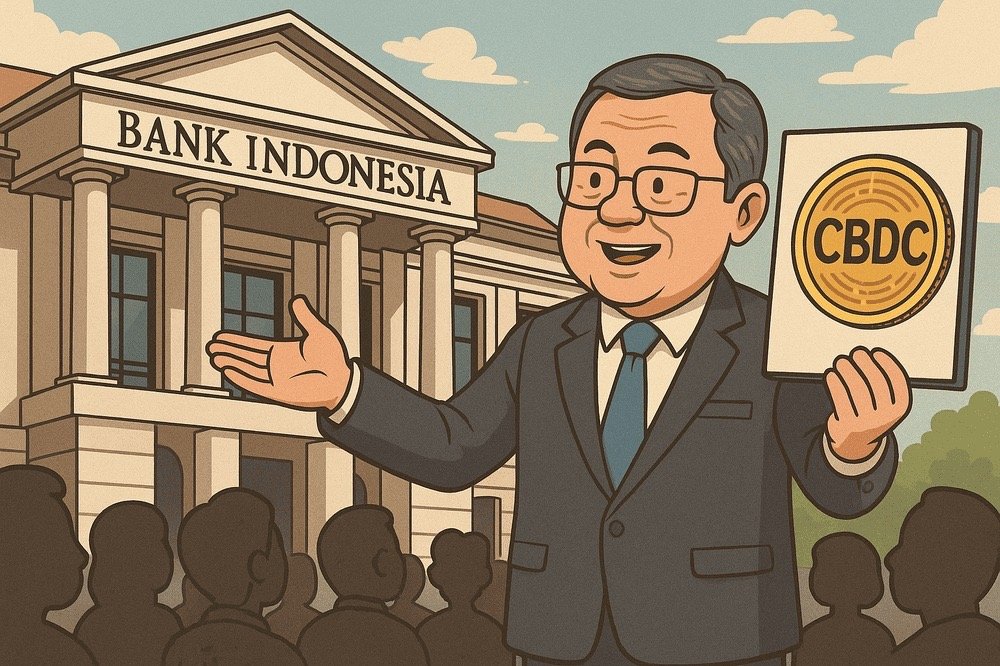
Indonesia is engaging this agenda. Public statements from Bank Indonesia indicate clear interest in exploring a rupiah digital and stablecoin models to support a secure and inclusive payments landscape. Such initiatives require robust digital infrastructure, strong privacy safeguards, and extensive public education so benefits are widely shared and risks are well understood.
The policy challenge is to balance innovation with equity. CBDC design choices must embed privacy protections, enable interoperability with existing payment rails, and include anti-abuse mechanisms. International experience suggests that without human-centered approaches—combining technical pilots with consumer education and social protections—digital monetary innovation risks widening digital divides rather than narrowing them.
Market participants and policymakers must modernize governance frameworks. Standardized reporting, institutional due diligence, smart-contract audits, and clear tax and investor-protection rules are essential. Countries that pair technical pilots with protective regulation and phased rollouts tend to achieve more stable and inclusive adoption.
From the investment side, asset managers need to recalibrate risk frameworks to reflect crypto volatility, the liquidity profile of new products, and technology risk. Governments must ensure digital infrastructure, data-protection regimes, and supervisory capacity are adequate to oversee hybrid markets. Scholars like Eswar Prasad note that technological readiness and regulatory competence are decisive for whether CBDCs and digital assets deliver sustained growth and stability.
The ethical and social dimensions are equally crucial. The question is not only which technologies we adopt, but for whom and to what end. Bung Hatta's vision of an economy grounded in mutual welfare reminds us that digital monetary tools must broaden collective wellbeing and not concentrate gains narrowly.
Indonesia stands at a crossroads. Accelerating digital transformation promises efficiency and inclusion, but only when technical, regulatory, educational, and ethical pillars advance together. The work ahead requires multilateral action: regulators, industry, academia, and civil society must co-design the rules, pilots, and education programs that shape how digital assets evolve.
Practical steps are actionable. First, build interoperable pilot environments that allow CBDC and regulated stablecoins to interoperate with retail payment systems and bank rails. Pilot programs should include measurable outcomes: reduction in transaction costs, speed of settlement, user uptake among underserved populations, and incident response times. Second, design privacy-preserving architectures. Techniques such as tiered privacy, selective disclosure, and privacy-enhancing cryptography can reconcile user confidentiality with oversight needs.
Third, implement proportionate regulation. Differentiate systemic payment utilities from speculative token markets so compliance burdens match systemic importance, and ensure consumer protections scale with risk. Fourth, invest in literacy and consumer protection. CBDC pilots should be paired with public campaigns explaining how digital money works, how to secure digital wallets, and how consumers can exercise remedies when things go wrong. Fifth, create proportional regulatory frameworks that differentiate systemic payment utilities from speculative token markets, so that consumer protections and capital requirements scale with systemic importance. Sixth, develop crisis playbooks: contingency plans for extreme market episodes and coordinated cross-agency responses that preserve financial stability.
Consider the macroeconomic and distributional implications. CBDCs can improve the transmission of monetary policy by allowing more direct instruments, but they may also change the liability structure of the banking system if retail deposits migrate to central-bank accounts. The design choices—interest-bearing or non-interest-bearing, account-based or token-based—have real consequences for financial intermediation. Policymakers must model these trade-offs transparently and communicate the findings to the public.
Empirical evidence from early adopters offers lessons. In the Bahamas and Nigeria, CBDCs have been associated with increased digital payments in low-infrastructure areas; in China, the e-CNY trial has revealed how a digital sovereign currency can integrate with existing fintech ecosystems while also providing data for macroprudential oversight. These experiences show potential gains but require careful local calibration.
Finally, the governance of digital-asset ecosystems must embed accountability. Independent audit, transparent reporting of pilot results, parliamentary oversight where relevant, and stakeholder consultation will enhance legitimacy. Internationally, harmonized standards around anti-money laundering, cross-border payments, and technical interoperability will lower barriers to adoption and reduce fragmentation.
This moment is political and social. As Indonesia charts its course, the nation has the opportunity to craft a model of digital money that reflects local priorities: inclusion, resilience, and shared prosperity. The question is whether leaders will seize the policy space to build systems that expand opportunity and protect citizens, or whether the digital turn will become another episode of concentrated gain and avoidable risk. The prudent choice is clear: pursue innovation guided by public purpose and robust safeguards. Act now, do it.