

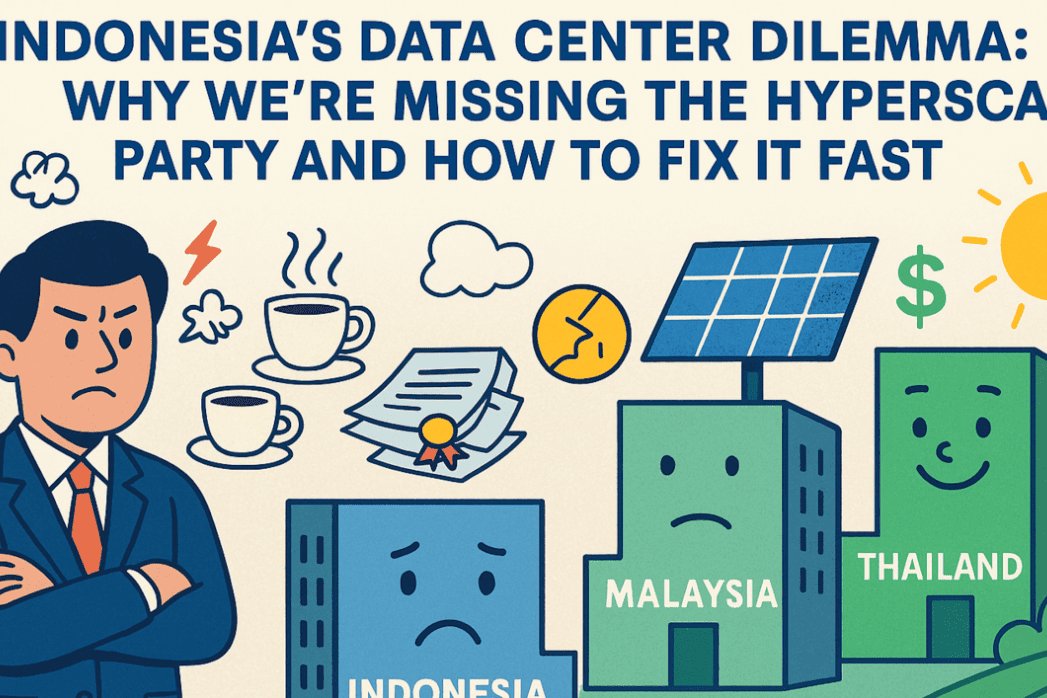
Indonesia, the rising digital giant of Southeast Asia, has all the right ingredients to dominate the region’s internet economy: a booming population, a massive market of smartphone-addicted users, and a vibrant startup scene. It’s the place where millions live online, shop online, and even find love online. So naturally, you’d expect Indonesia to also be the go-to destination for data centers — those big, humming warehouses that store all our precious cloud stuff. But here’s the twist: while our neighbors Malaysia and Thailand are raking in billions in hyperscale data center investments, Indonesia is still sitting on the sidelines, trying to get its paperwork in order.
So, what gives? Why are the Googles, Amazons, and Microsofts of the world throwing money at Johor and Bangkok while tiptoeing around Jakarta? And more importantly, what can Indonesia do to stop missing out on the digital infrastructure gold rush? Buckle up, because this story has it all: power struggles, paperwork nightmares, tectonic drama, and even a bit of tech romance.
POWER TO THE (DATA) PEOPLE? NOT QUITE YET. Let’s start with electricity — the lifeblood of any data center. These facilities aren’t just fancy buildings with blinking lights. They’re energy guzzlers, requiring stable, scalable, and increasingly green power to run 24/7. Now, Indonesia does have electricity — lots of it, in fact. But here’s the problem: it’s often unreliable, overly centralized, and still heavily reliant on coal. In 2023, only 13% of the country’s energy mix came from renewables. Not exactly the kind of stat you want on your investor pitch deck when your client is a climate-conscious cloud giant.
Compare that with Malaysia, which rolled out a “Green Lane Pathway” to fast-track power approvals for data centers. It promises connections in under 12 months and throws in some solar panels for good measure. Thailand? Also ahead of the curve, offering discounted electricity tariffs for sustainable infrastructure projects. Meanwhile, in Indonesia, it’s not unusual for a project to get stuck in limbo while waiting for grid access or renewable energy assurances. Hyperscalers aren’t into uncertainty. They want guarantees, not guesses.
BUREAUCRACY: THE SILENT KILLER OF MOMENTUM If there’s one thing Indonesia is world-class at, it’s paperwork. Starting a data center here often feels like a bureaucratic maze where each turn leads to a new permit, a new agency, or another “recommendation letter” that needs to be stamped, signed, and sung over. Yes, Indonesia offers tax holidays and has eased up on foreign ownership rules. But the practical reality? Projects get delayed. Land use permits get tangled in local politics. Environmental approvals turn into mini soap operas.
Meanwhile, Malaysia has its Digital Investment Office, a one-stop shop where hyperscalers can get everything sorted in one place, like ordering pizza with extra fiber connectivity. Thailand’s Board of Investment rolls out incentives, fast-tracks decisions, and throws in subsidies for good behavior. It’s no wonder big tech is flocking there. They love efficiency almost as much as they love the cloud.
EARTHQUAKES, ERUPTIONS, AND WHY INSURANCE COMPANIES GET NERVOUS Let’s talk geography. Indonesia is beautiful, no doubt. But it also sits right on the Ring of Fire, which sounds cool until you realize it’s a literal hotbed of earthquakes, volcanic eruptions, and tsunamis. Building data centers here isn’t just about finding land and plugging into the grid. It’s about engineering facilities that won’t turn into rubble during the next tectonic tantrum.
This means more capital expenditures, stricter design standards, and yes, higher insurance premiums. It’s not that it can’t be done — just that it costs a lot more. Meanwhile, Malaysia and Thailand, while not totally risk-free, are far less dramatic geologically. From an investor’s point of view, it’s like choosing between a house on the beach or one next to a volcano.
WHERE ARE ALL THE DATA CENTER NERDS? Even if you’ve got the land, the power, and the permits, you still need people who actually know how to build and run these things. And here’s another pinch point for Indonesia: we’re short on skilled talent. Cloud engineers, HVAC specialists, cybersecurity experts — they’re in high demand and low supply. Most companies end up flying in expensive expats or poaching talent from Singapore.
Malaysia, on the other hand, benefits from its proximity to Singapore’s talent pool and is investing heavily in upskilling its own tech workforce. Thailand has its Digital Economy Promotion Agency pushing education and certification programs for future tech workers. Indonesia is trying — but current efforts are patchy and too small in scale to support the kind of explosive growth the country is aiming for.
TOO MANY PLAYERS, NOT ENOUGH STRATEGY Here’s another wrinkle: the market in Indonesia is fragmented. Over 68 operators are jostling for space, mostly in Jakarta and Batam. It’s overcrowded, competitive, and often uncoordinated. Without a national roadmap, the result is chaos — like trying to build a city without a zoning plan.
Contrast that with Malaysia’s dual-core strategy: focus on Kuala Lumpur for enterprise, Johor for hyperscale. Thailand is doing the same with Bangkok and Rayong. These countries are playing chess while Indonesia is playing musical chairs. Until Indonesia picks a few zones to prioritize, invests in backbone infrastructure there, and markets them aggressively, we’re going to keep losing out to the better-packaged neighbors.
GREEN IS THE NEW GOLD Let’s not forget sustainability. Every hyperscaler has made public commitments to go carbon neutral or 100% renewable by a certain year. They’re not just chasing cloud revenue — they’re also chasing ESG scores. So if your electricity comes from coal, and your solar farms are still stuck in environmental review, that’s a dealbreaker.
Indonesia does have sun, wind, and geothermal potential. But it needs to unlock it fast. That means allowing private sector PPAs, fast-tracking green energy permits, and — radical idea — maybe letting data centers build their own renewable supply.
SO WHAT SHOULD INDONESIA DO (LIKE, RIGHT NOW)? Enough doom and gloom. Let’s talk solutions. Here’s how Indonesia can stop missing the party and start hosting it:
Set up a dedicated Digital Infrastructure Task Force. Give it teeth. Make it cut across ministries and actually get things done. Think of it as the data center version of the toll road authority. Simplify the entire permitting process. Put everything online, set strict timelines, and assign accountability. If someone misses a deadline, they don’t get to chair the next FGD. Unlock green energy now. Don’t wait for the perfect policy. Open up direct access to renewables, incentivize utility-scale solar and geothermal, and give data centers guarantees they can brag about to their ESG auditors. Create data center zones outside Java. Think Surabaya, Bali, Kalimantan. Build power and fiber corridors there, throw in tax breaks, and market them as future-proof hubs. Jakarta is full. Invest in talent — at scale. Work with tech giants to build national training programs. Turn vocational schools into data center academies. Make this industry sexy for the next generation. Market Indonesia aggressively. Create a national brand: “Indonesia: The Future of Asia’s Digital Core.” Bring it to Singapore, San Francisco, and Seoul. Make noise.
FINAL BYTE Indonesia isn’t doomed. In fact, we might be the sleeping dragon in the regional data center race. But if we want to win, we need to wake up fast and get our act together. The market is huge. The potential is real. The question is whether we’re ready to move from "almost there" to "absolutely essential."
Because in the world of data, nobody remembers the country that nearly became a hub. They remember