

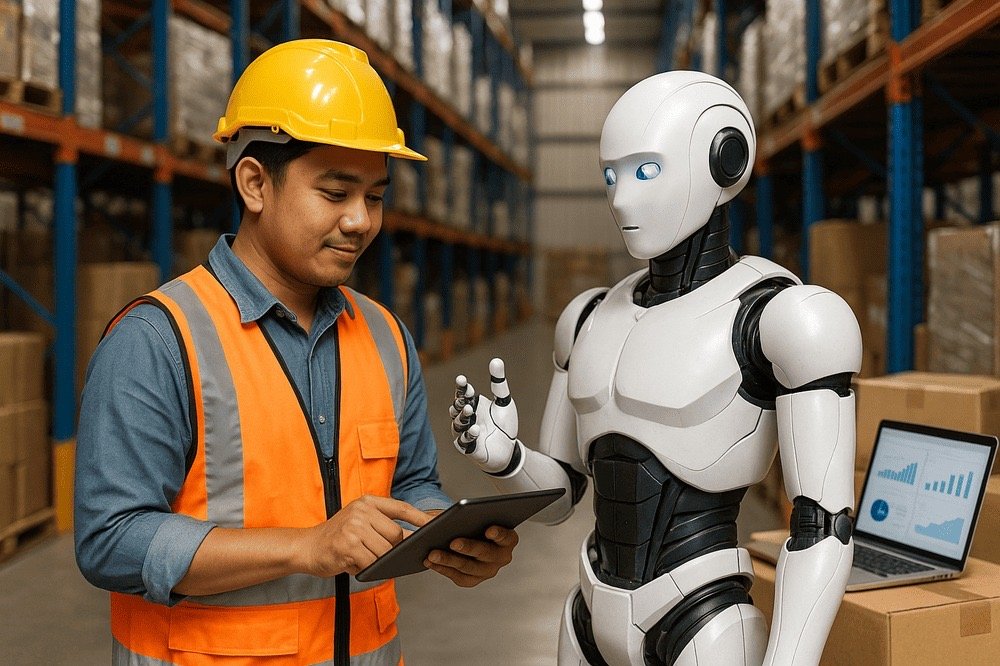
Without technology, humans struggle to progress. Yet without humans, technology itself loses direction and meaning. This is not just a rhetorical opening, it reflects a reality that defines how modern industries evolve.
Technology is advancing at a remarkable pace, followed closely by rapid shifts in business dynamics. Humanity must adapt to this acceleration, and few sectors experience this transformation more profoundly than logistics. Advanced innovations such as artificial intelligence, the Internet of Things, robotics, and even humanoid systems are now driving forces in improving efficiency, transparency, and competitiveness across global supply chains. Data from PwC shows that corporate activity and investment in transportation and logistics remain strong. Investors are increasingly drawn to infrastructure and digital capabilities as key growth enablers, with many companies now prioritizing technology acquisition as part of their long term strategy. According to the Boston Consulting Group, combining digitalization, automation, decarbonization, and talent development can significantly enhance profitability by improving operational margins and closing productivity gaps between logistics and other industries.
Deloitte’s research highlights how artificial intelligence is rewriting the rules of logistics operations. AI can refine demand forecasting, optimize delivery routes, and automate administrative tasks that traditionally increase overhead costs. The growing use of generative AI offers even greater potential to improve efficiency while reducing carbon emissions through smarter routing and resource planning.
In Indonesia, however, classical logistical challenges persist. The country’s vast geography, fragmented infrastructure, and skill shortages remain key hurdles. McKinsey’s analysis suggests that inefficiencies in transfer points between mid mile and last mile operations can contribute between 13 and 19 percent of total logistics costs a figure that reflects the untapped potential for improvement through digital integration.
This brings us back to the human factor. A technologically capable workforce is essential. It is no longer enough to have digital literacy; workers must be able to execute technology in practice, operating warehouse management systems, managing IoT sensors, reading analytics dashboards, and responding to automated alerts. The Sepuluh Nopember Institute of Technology has long emphasized the importance of education and research programs that develop logistics talents ready to meet industry demands.
Private companies in Indonesia are already taking steps toward digital transformation. Major logistics firms are using real time fleet management systems, predictive analytics to handle peak demand, and integrated fulfillment services to help small and medium enterprises compete more efficiently. Investments in warehouse automation and digital control towers that monitor end to end operations have become central to competitiveness. PwC’s global analysis found that companies adopting multiple digital use cases achieved higher asset utilization and stronger returns on capital.
State owned enterprises are also evolving. PT Pos Indonesia, which has transitioned from a postal operator into a logistics service provider, has implemented RFID tracking, automated sorting systems, and digital customer interfaces to enhance service speed and accuracy. Academic case studies highlight PT Pos’s use of data driven performance management and structured OKR frameworks as critical components of its transformation.
Still, the harmony between humans and machines does not emerge automatically. Scholars and supply chain experts advocate for a layered model of human machine collaboration that includes redesigned workflows, continuous learning programs, and interoperable systems accessible to local workers. The central principle is clear: technology should expand human capability, not replace it.
To bridge the gap, Indonesia needs concrete operational and policy strategies. Pilot programs integrating digital solutions across strategic logistics corridors, such as maritime highways, regional ports, and interprovincial routes, should serve as testbeds before scaling nationally. Data standards and interoperability protocols must be established so that digital investments do not end up as isolated systems.
Regional training centers, developed through partnerships between industry and academia, could provide certification modules tailored to market needs. Such programs would bring reskilling opportunities to port workers, warehouse operators, and micro logistics players.
Sustainability should also be embedded across operations, from low emission last mile fleets to energy efficient warehouse designs. With synchronized technology, human capital, and policy direction, Indonesia’s geographic complexity can become a strategic advantage rather than a logistical obstacle.
The rise of technology must signal the rise of Indonesia’s human potential. With the right strategy, technological advancement will not eliminate jobs but create high value opportunities. When workers are equipped to maintain sensors, operate autonomous warehouses, and analyze logistics data, they become the new engine of local economic growth.
Technology and humanity are not opposing forces they are two sides of the same coin. If Indonesia succeeds in harmonizing the two through coherent policy, sustained investment, and forward looking education, the nation’s digital logistics revolution will not only accelerate the movement of goods but also advance shared prosperity across the archipelago.