

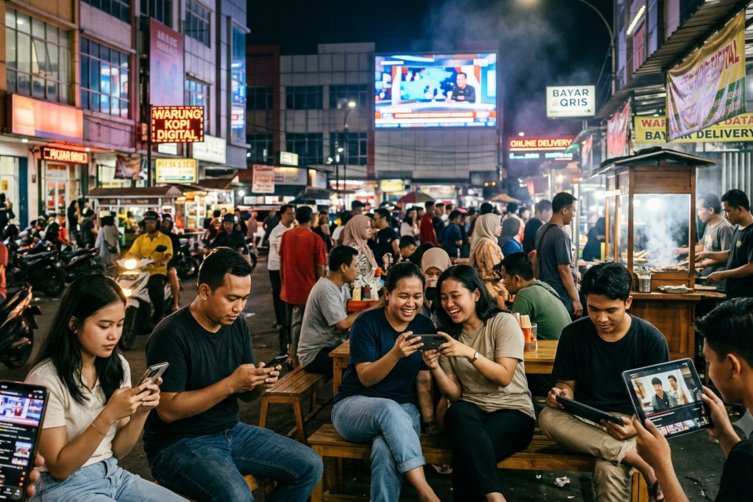
The atmosphere of nobar in the village still lingers in memory. A large tube television placed on the house terrace, mothers preparing fried snacks and black coffee, children crowding together on plastic mats, and everyone immersed in the same shared emotion. The atmosphere was lively, warm, and spontaneous. That was the face of Indonesia when welcoming every World Cup. A people’s festival in its purest form.
The 2026 World Cup has just concluded. Spain emerged as champion after defeating Argentina 1-0 with a goal by Ferran Torres in the 106th minute of extra time at MetLife Stadium, New Jersey. Throughout the tournament, La Roja conceded only one goal, the best defensive record for a World Cup champion in history. A remarkable achievement. Yet in Indonesia, the more interesting question is not who won, but how we watched it and how this change opens new opportunities for business.
From Shared Screens to Individual Screens
A few decades ago, nobar was the primary way Indonesian society enjoyed the World Cup. During the 2002 World Cup in Korea and Japan, 2006 in Germany, and even 2010 in South Africa, coffee shops, village halls, and residents’ yards became open “people’s stadiums” for anyone. This was a collective viewing experience, united on one screen, one emotion, and one moment.
Today, the landscape has fundamentally changed. The 2026 Digital Report from We Are Social and Meltwater shows that Indonesians spend an average of 21 hours and 50 minutes per week on social media, spread across an average of 7.7 different platforms each month. Indonesia has 230 million internet users with 80.5 percent penetration and more than 210 million smartphone users. TikTok absorbs 44 hours and 54 minutes per month per user, while YouTube leads in session duration with nearly 17 minutes per opening.
As a result, the way society consumes World Cup content has shifted. Many now follow the tournament through highlights, memes, or short video clips without watching full matches. FIFA itself recorded that social media engagement for the 2022 Qatar World Cup surged 448 percent from the 2018 edition, with 3.6 billion video views on official channels. For 2026, this trend has grown even stronger. The World Cup is no longer merely a television event but a digital phenomenon consumed in fragmented form.
This is not about lost excitement, but about excitement that has moved elsewhere. From large screens in village halls to millions of small screens held in the hands of villagers.
The Logic Behind the Shift
To understand this phenomenon, we can refer to the concept of the attention economy, first formulated by Nobel Prize-winning economist Herbert A. Simon in 1971. Simon explained that the abundance of information creates a scarcity of attention. The more content available, the more limited human capacity becomes to give full attention to any single thing.
In the context of the World Cup, data supports this theory. FIFA projects that the 2026 World Cup reached 6 billion people globally, a 20 percent increase from Qatar 2022’s 5 billion. Absolute numbers rose, yet the proportion of attention given to any single match declined because viewers now have far more diverse entertainment choices. According to Nielsen, streaming accounted for 44.8 percent of total viewing time in the United States in May 2025, surpassing the combined share of broadcast and cable for the first time.
In Indonesia, this competition for attention is even more intense. The OTT (over-the-top) market is valued at around US$5 billion with highly diverse players, including Netflix, Disney+, Vidio, Viu, WeTV, and others. The digital advertising market reached US$3.41 billion in 2026 according to Mordor Intelligence, with video formats commanding 34 percent of total spending. This means every content, including the World Cup, must compete for the same consumer time and attention.
Business Opportunities in the Digital Market
For sharp-eyed business players, this shift is not a threat but an opportunity. There is momentum in every wave of change. The question is how to read that momentum and ride the wave of transformation in entertainment platforms.
First, capitalize on short-form content momentum. With 108 million adult TikTok users in Indonesia and an average usage of 44 hours per month, short-video platforms offer highly potential distribution channels. Businesses can create content linking their brands to major moments like the World Cup without purchasing broadcasting rights or incurring massive costs. Creativity becomes the primary capital here.
Second, do not overlook connected-TV potential. CTV advertising is the fastest-growing segment in Indonesia’s digital advertising ecosystem. Data shows 83 million OTT users streaming 3.5 billion hours per month, with half of them willing to watch four or more ads per hour. This is premium inventory that advertisers should seriously consider.
Third, build multi-platform strategies. The era when one channel could reach everyone has passed. With Indonesians using an average of 7.7 platforms each month, businesses need to distribute content and advertising spending more evenly across platforms, from social media to streaming, from YouTube to podcasts.
Fourth, collaborate with the creator economy. Indonesia’s creator economy reached Rp450 trillion according to Bank Indonesia data in 2025, with 12 to 15 million active creators. Collaborations with local creators who have niche audiences, such as football, lifestyle, or culinary content creators, deliver far more authentic and effective reach than conventional advertising.
Fifth, prepare businesses for live commerce. In Indonesia, 60 percent of online buyers now shop through live streaming sessions, and video commerce contributed 20 percent of e-commerce GMV in 2025, up from less than 5 percent in 2022. Businesses that integrate major cultural and sports moments into their live commerce strategies will gain a competitive edge.
Finally, Indonesia’s digital economy is projected to reach US$130-150 billion by the end of 2026 according to the ProSpace Research Institute. This growth is driven by smartphone penetration in second- and third-tier cities. Businesses that can reach markets outside Java with locally relevant content and services will capture the next wave of growth.
The Only Constant Is Change
I recall a wise message from the Greek philosopher Heraclitus that remains relevant today. There is nothing permanent except change itself. No one steps in the same river twice, for the water is always different.
The way we watch the World Cup has changed. The way we gather has changed. The way businesses reach consumers has changed. And all of this should not be resisted but understood and anticipated.
Spain celebrated its second title in front of 82,000 spectators in New Jersey. Ferran Torres, the sole goal scorer in the final, said the goal belonged to Spain’s 47 million people. For Indonesia, however, the lesson from the World Cup is different and simpler. Excitement does not have to take the same form as before to remain meaningful. What matters most is that, as a society and as business players, we must be adaptive, flowing with change rather than against it. Because as Heraclitus said, the only constant is change itself.